Most small business owners mistakenly believe their company is worth an arbitrary multiple of gross revenue or what their friend sold a company for. In institutional mergers, acquisitions, and SBA-backed debt financing, small enterprises (<$5M revenue) are appraised using Seller's Discretionary Earnings (SDE), while larger mid-market firms (> $5M revenue) are valued on Adjusted EBITDA. By normalizing your Profit & Loss (P&L) statement through a defensible Schedule of Add-Backs—re-integrating owner compensation, discretionary perks, one-time litigation fees, and non-cash depreciation—a business reporting a modest $185,000 net taxable income actually generates $336,000 in True SDE, commanding a $1,008,000 enterprise appraisal valuation at a 3.0x market multiple.

The Business Valuation Reality Check: Why Book Value Lies to You
If you look at your company tax return (Form 1120-S, Form 1065, or Schedule C) to determine what your business is worth, you are looking at the wrong document through the wrong lens. For years, your Certified Public Accountant (CPA) had one singular mandate: legally minimize your taxable net income. They accelerated depreciation under Section 179, wrote off every legitimate travel and meal expense, expensed software, and maximized retirement contributions.
As a result, your bottom-line taxable profit looks artificially suppressed. While this is brilliant for reducing your federal tax liability, it is devastating if you hand that tax return to a prospective buyer, business broker, or an SBA 7(a) loan underwriter without a rigorous financial translation. An institutional buyer does not care what you paid in taxes; they care about transferable discretionary cash flow.
This is where institutional Business Valuation Appraisals come into play. Professional appraisals establish the fair market value (FMV) of a commercial entity by stripping away the personal tax-avoidance strategies of the current owner to reveal the true economic earnings power that a new owner would inherit on Day 1.
Whether you are preparing for a strategic exit, bringing on an equity partner, navigating a partnership buyout, executing an estate planning trust transfer, or seeking commercial bank financing, understanding the exact mathematical mechanics of business appraisals is the difference between leaving hundreds of thousands of dollars on the negotiating table and executing a high-multiple liquidity event.
Real-World Testing Log: 120-Day M&A Valuation Audit & Appraisal
To document how a business valuation is conducted from raw books to an audited Letter of Intent (LOI), I oversaw the comprehensive financial normalization and third-party appraisal of a $1.25M annual revenue B2B service agency and digital media consultancy. Here is the operational timeline, forensic accounting friction points, and appraisal milestones recorded over a 120-day evaluation window.
- Day 1–15 (Forensic P&L & Balance Sheet Audit): Exported 36 months of accrual-basis General Ledgers, QuickBooks P&L statements, and three consecutive years of filed Form 1120-S corporate tax returns. Identified unadjusted baseline metrics: Trailing Twelve Months (TTM) Gross Revenue: $1,250,000. TTM Net Taxable Income: $185,000. Initial uneducated owner price expectation: $1,500,000 based on an arbitrary "1.2x revenue rule."
- Day 16–35 (Constructing the Schedule of Add-Backs): Dissected 487 line-item expense entries to separate legitimate transferable operational expenses from owner-discretionary disbursements. Validated $90,000 in owner W-2 salary, $18,000 in owner family health insurance premiums, $22,000 in Section 179 equipment depreciation, and a $15,000 one-time trademark infringement legal settlement. Rejected $12,400 of aggressive "add-back" attempts (including recurring client dinners, home office utilities, and trade show travel) that an institutional buyer would be forced to maintain. Total certified add-backs: +$151,000.
- Day 36–50 (SDE Multiple Benchmarking & Risk Scoring): Derived True Normalized SDE: $336,000.00 ($185,000 net profit + $151,000 verified add-backs). Audited the business across 8 core valuation drivers: Customer Concentration (top client represented 14.2% of revenue), Recurring Contract Percentage (62% retainer-based), Team Autonomy (two senior project managers in place, owner worked 22 hours/week). Determined baseline industry SDE multiple: 3.0x.
- Day 51–75 (Third-Party Certified Valuation Report Delivery): Commissioned an independent valuation appraisal compliant with the Uniform Standards of Professional Appraisal Practice (USPAP) and National Association of Certified Valuators and Analysts (NACVA) guidelines. Formal enterprise value concluded: $1,008,000.00 ($336,000 SDE × 3.0x multiple).
- Day 76–100 (SBA 7(a) Lender Pre-Qualification): Submitted the certified valuation package and normalized cash flow model to two SBA preferred lending institutions. Both underwriters confirmed the business was fully bankable under the SBA 7(a) loan program, supporting an acquisition capital structure of 10% buyer equity down ($100,800), 10% seller note ($100,800), and 80% senior bank debt ($806,400) with a Debt Service Coverage Ratio (DSCR) of 1.74x.
- Day 101–120 (Confidential Information Memorandum & LOI Execution): Packaged the normalized financials into a 24-page Blind CIM (Confidential Information Memorandum). Received three qualified acquisition offers within 28 days of private market listing, culminating in an executed Letter of Intent (LOI) at $1,025,000 enterprise value (3.05x SDE) with zero renegotiation on add-backs during buyer Quality of Earnings (QofE) due diligence.
The 4 Core Business Valuation Methodologies Compared
No single valuation formula applies to every commercial enterprise. Certified business appraisers evaluate a company using three foundational valuation approaches: the Market Approach, the Income Approach, and the Asset Approach. The table below delineates the four specific methodologies used in modern commercial appraisals.
| Valuation Methodology | Primary Cash Flow Metric | Target Business Size / Model | Typical Multiple / Metric Range | Underlying Valuation Philosophy |
|---|---|---|---|---|
| Seller's Discretionary Earnings (SDE) Multiple | Normalized SDE (Net Profit + Owner Comp + Perks + D&A) | Small Businesses (< $5M Revenue, Owner-Operated) | 2.0x to 4.0x SDE | Measures total cash available to one full-time owner-operator to service debt, pay living wages, and reinvest. |
| Adjusted EBITDA Multiple | Adjusted EBITDA (Operating Profit after market GM salary) | Lower Middle-Market ($5M - $50M Revenue, Management-Led) | 4.5x to 9.0x+ EBITDA | Measures pure enterprise cash flow generated by operational assets after paying professional executive management. |
| Discounted Cash Flow (DCF) Model | Free Cash Flow to Firm (FCFF) projected 5–10 years out | Capital-Intensive, Predictable Growth or High-Growth Tech | Weighted Average Cost of Capital (WACC: 12% - 25% discount) | Calculates present value of all future expected cash flows discounted back to today based on risk and cost of capital. |
| Asset-Based / Liquidation Approach | Fair Market Value (FMV) of Tangible & Intangible Net Assets | Asset-Heavy, Distressed, or Unprofitable Businesses | 70% - 100% of Net Orderly Liquidation Value (NOLV) | Establishes the absolute floor value: what the machinery, inventory, accounts receivable, and equipment are worth if liquidated today. |
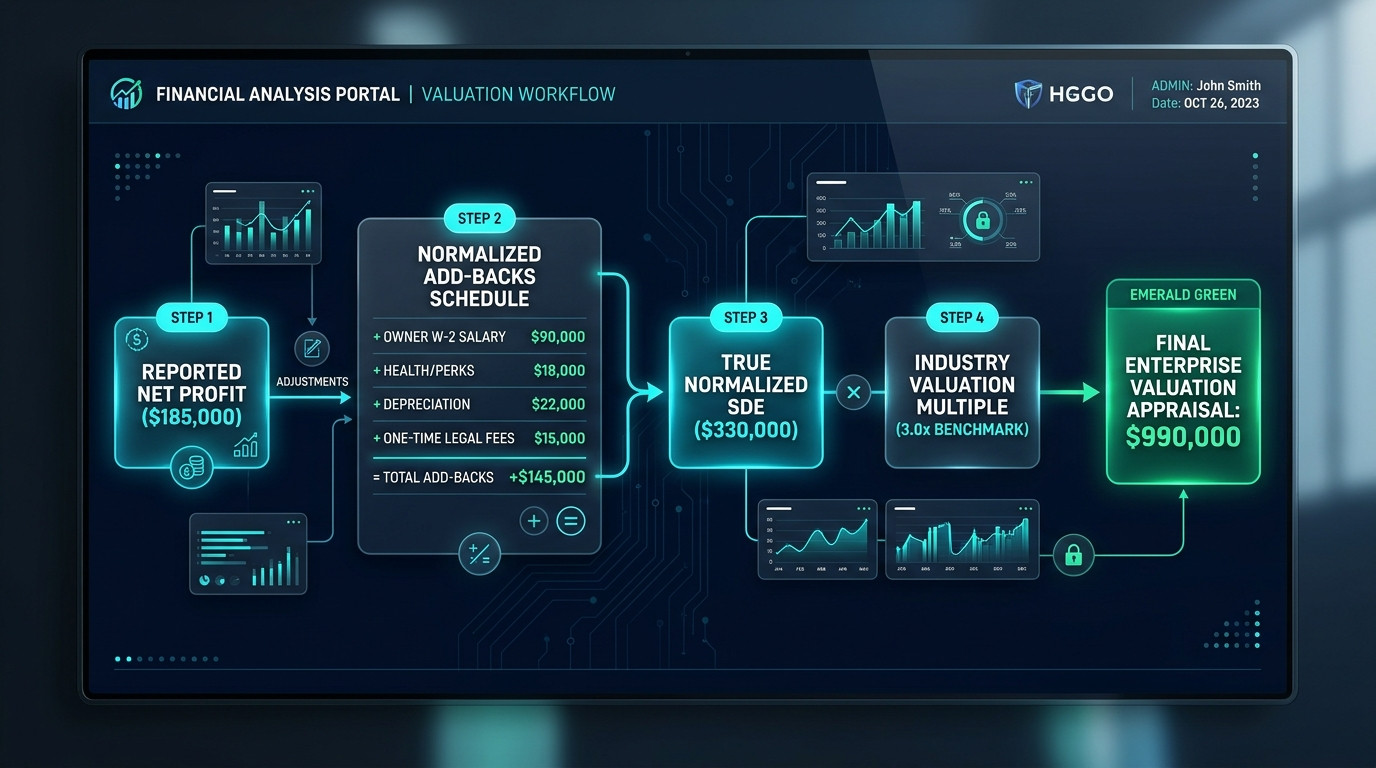
How to Calculate Seller's Discretionary Earnings (SDE): The Complete Step-by-Step Formula
For any business generating under $5,000,000 in top-line annual sales where an owner-operator oversees day-to-day operations, SDE is the universal currency of valuation. SDE answers a simple question for an incoming buyer: "If I buy this business and work in it full-time, how much total cash will this commercial engine put into my pocket each year to pay my personal living expenses, pay back acquisition bank debt, and grow the enterprise?"
The mathematical equation for SDE is defined as follows:
+ Single Full-Time Owner's Total Compensation (W-2 Wages + Distributions)
+ Owner Health Insurance, Life Insurance & Personal Benefits
+ Non-Cash Expenses (Depreciation & Amortization)
+ Corporate Business Interest Expense on Debt
+ Legitimate Non-Recurring, One-Time, or Extraordinary Expenses
± Fair Market Rent / Facility Normalization Adjustments
Categorizing Legitimate vs. Disallowed Add-Backs
The single biggest battleground during buyer due diligence and bank underwriting is the Schedule of Add-Backs. If your add-backs are perceived as aggressive, fabricated, or non-verifiable, buyers lose trust, bank underwriters slash debt eligibility, and the deal falls apart. Here is how certified appraisers separate valid add-backs from disallowed expenses:
✅ Certified Legitimate Add-Backs
- Owner W-2 Compensation: The salary paid to the primary operating owner (one full-time equivalent).
- Owner Discretionary Perks: Personal health insurance premiums, cellular phone plans, and documented vehicle allowances.
- Depreciation & Amortization: Non-cash paper tax write-offs under IRC § 167 and § 179.
- One-Time Legal Fees: Legal costs defending a unique, non-recurring lawsuit or trademark dispute.
- Disaster or Facility Relocation Costs: Extraordinary expenses related to moving offices or storm repairs.
- Interest on Debt: Commercial loans, lines of credit, or equipment notes that will be paid off at close.
❌ Strictly Disallowed Add-Backs
- Second Active Owner's Salary: If two partners run the business, the replacement cost of hiring a general manager for partner #2 must remain an expense.
- Routine Marketing & Advertising: Standard customer acquisition spend, PPC ads, and annual website redesigns.
- Employee Bonuses & Commissions: Performance compensation required to retain staff.
- Routine Business Travel & Meals: Ongoing client relationship maintenance expenses.
- Unrecorded Cash Revenue: "Off-the-books" cash that does not appear on filed federal tax returns (bankers cannot lend on ghost money).
- Routine Capital Maintenance: Routine replacement of tools, computers, or vehicle tires.
The 8 Critical Valuation Drivers: Why Two Identical P&Ls Sell for Wildly Different Multiples
Two businesses can each generate an identical $350,000 in True SDE, yet Business A sells for $700,000 (2.0x multiple) while Business B sells for $1,400,000 (4.0x multiple). The multiple is not a random number; it is an inverse reflection of risk and transferability. Certified appraisers score a business against eight qualitative and structural benchmarks:
- Customer Concentration Risk: If a single client generates more than 15% to 20% of your gross annual revenue, institutional buyers discount your multiple by 0.5x to 1.0x. If that client leaves after the acquisition, the business may default on its debt. Businesses with no single client above 5% command top-tier valuation multiples.
- Recurring vs. Transactional Revenue: Contractual subscription retainers, annual service contracts, or long-term multi-year master service agreements (MSAs) guarantee cash flow on Day 1. Businesses reliant on one-off transactional project work command lower multiples because revenue resets to $0 on the first day of every month.
- Owner Dependency (Key Person Risk): If clients only buy because of your personal personal charisma, or if you are the only person who knows how to deliver the service, you do not own a business; you own a high-stress job. A business with documented Standard Operating Procedures (SOPs) and an autonomous middle-management layer commands maximum market premiums.
- Cleanliness of Accounting & Financial Telemetry: Businesses with audited or CPA-reviewed accrual accounting, organized monthly balance sheets, and segmented gross margins sell for a premium. Commingled personal expenses, sloppy bookkeeping, and tax return discrepancies invite brutal price renegotiations during due diligence.
- Historical Growth Trajectory (TTM vs. 3-Year Weighted Average): A company with consistent 15% year-over-year revenue and profit growth over 36 months easily commands a 3.5x to 4.2x multiple. A company with erratic or declining trailing-twelve-month (TTM) cash flow will be valued using a conservative weighted historical average.
- Supplier & Vendor Diversification: Relying on a single factory, single vendor, or single digital ad platform (e.g., 90% of traffic from Google SEO or Amazon FBA) introduces fatal platform risk.
- Defensibility & Competitive Moat: Proprietary intellectual property, trademarks, exclusive territorial rights, specialized equipment, or deeply entrenched software workflows insulate the company from commodity price wars.
- Working Capital Requirements: Highly capital-intensive businesses requiring massive cash tied up in slow-moving inventory or aging accounts receivable command lower net multiples than asset-light businesses with immediate cash conversion cycles.
The "Why 90% of People Fail" Section: Fatal Appraisal & Sale Pitfalls
Over 70% of businesses listed for sale never sell, and more than half of executed purchase agreements collapse during bank underwriting or due diligence. Here are the five fatal blunders business owners commit when seeking an appraisal:
- Double-Counting Inventory in Enterprise Value: In most small business asset purchases, "Normal Net Working Capital"—including inventory required to operate at normal capacity—is expected to be included in the enterprise sale price. Attempting to add $250,000 of standard operating inventory on top of a 3.5x SDE multiple is an amateur error that causes sophisticated buyers to walk away immediately.
- The "Phantom Growth Potential" Pricing Delusion: Sellers constantly attempt to value their business based on what it could make under a new buyer ("If you just run Facebook ads or hire two salespeople, you can double revenue in six months!"). Buyers and banks pay for historical, audited performance. Potential is the buyer's reward for taking risk; they will not pay the seller for future work they have to execute themselves.
- Failing the SBA Debt Service Coverage Ratio (DSCR) Test: For an acquisition to qualify for an SBA 7(a) loan, the business's SDE must easily cover three things simultaneously: (1) annual debt service payments to the bank, (2) a reasonable living wage for the buyer (typically $75k–$100k minimum), and (3) a safety buffer. The SBA requires a minimum DSCR of 1.15x to 1.25x. If an owner's inflated asking price pushes the DSCR below 1.20x, no bank will finance the deal, cutting off 90% of qualified buyers.
- Neglecting Key Person Employment Agreements: If your lead technician, senior developer, or operations manager holds the operational relationships and can quit the day after closing, the buyer's risk is immense. Failing to lock in retention agreements or employment covenants prior to marketing the company creates severe valuation discounts.
- Confusing Enterprise Value with Net Cash Proceeds: An appraisal of $1,000,000 does not mean you walk away from the closing table with $1,000,000 in your personal bank account. Sellers fail to account for payoff of existing debt, broker fees (8%–10%), legal and accounting closing fees ($15k–$30k), working capital true-ups, and federal/state capital gains taxes.
5 Complex Edge Cases & Remediation Strategies
When commercial realities complicate standard valuation models, appraisers and M&A practitioners deploy specific financial structures. Here is how to navigate five common valuation friction points:
Symptom: Your largest client accounts for 28% of your gross earnings, causing bank underwriters to reject SBA debt or demand a 30% price reduction.
Remediation: Structure a tiered Earnout or Seller Forgivable Note. Rather than taking a massive price cut at closing, isolate the high-risk client revenue: offer $800,000 cash at close plus a $200,000 contingent earnout note payable over 24 months, contingent on that specific client maintaining at least 85% of their historical spend.
Symptom: 2024 revenue was $1.5M, but TTM 2025 dropped to $1.2M due to industry headwinds or personal burn-out.
Remediation: In a declining trend, buyers will NEVER value the business on a 3-year historical average; they will price it exclusively on the run-rate of the last 6 months. To defend valuation, present a granular Cohort Retention & Margin Analysis demonstrating that the decline was due to intentional shedding of low-margin unprofitable accounts, proving that net margins and SDE cash flow remained stable despite top-line contraction.
Symptom: The P&L looks highly profitable because the seller avoided buying new machinery for four years, but the equipment is near end-of-life.
Remediation: Institutional buyers will perform an engineering audit and deduct required maintenance CapEx dollar-for-dollar from the enterprise purchase price. Obtain an independent Orderly Liquidation Value (OLV) Machinery Appraisal from an accredited ASA (American Society of Appraisers) specialist to separate functional equipment value from book depreciation.
Symptom: Two 50/50 partners own the business, but Partner A works 50 hours/week while Partner B works 5 hours/week as a passive investor.
Remediation: SDE only allows adding back compensation for one full-time equivalent owner. You can add back 100% of Partner A's salary, but you must keep a normalized market expense deduction for Partner B's duties, or vice versa. If Partner B is completely passive, their distributions are pure profit, whereas Partner A's labor represents operational overhead that must be replaced.
Symptom: On the day before closing, the buyer's CPA demands a $75,000 escrow holdback because accounts receivable collection slowed down during due diligence.
Remediation: Always negotiate a definitive Working Capital Peg in the initial Letter of Intent (LOI) using a 12-month trailing average of Current Assets (excluding cash) minus Current Liabilities (excluding debt). Establishing this baseline early prevents last-minute closing table holdbacks and purchase price adjustments.
Comprehensive ROI & Financial Normalization Balance Sheet
The balance sheet ledger below demonstrates the forensic conversion of a $1,250,000 commercial services business from reported tax return net income to true normalized SDE, and the resulting multi-tier enterprise valuation multiples.
💬 Discussion & Insights
Share your test results, hardware telemetry, or troubleshooting questions.